Demi-paire, Halloween et le verbe venir
Where have the last two months gone?? With my apologies for the lateness, here are handouts and links for topics we've covered in October and November 2019.
1. Movie: Demi-paire
Demi-paire is a court-métrage (short film) by Yannick Pecherand-Molliex. The movie itself is silent, but we used it in class as a way to practice descriptions.
I've adapted my class handout from the document created by the Institut Français. (Their document includes an answer sheet and some information about the film's author. It's designed for the teacher, though, so it's not easy to understand.)
2. Joyeuse Halloween !
 Halloween was almost unknown in France fifteen years ago, but now it's everywhere. Cultural enrichment or commercial exploitation? You decide...
Here are the activities we did in class:
You may also enjoy these online games and activities:
3. Venir de, être en train de
One of the grammar points in Chapter 15 of French Made Simple is the conjugaison of the verb venir. I took this opportunity to introduce the recent past (venir de) and the present progressive (être en train de).
 Charlie is the French counterpart of Waldo in Martin Handford's famous children books. The author of the blog "La langue FLE rit" had the great idea to use one of these images, found on the web, as a support for describing actions using the recent past and present progressive. I happily borrowed the idea.
Here is the class handout I created to explain the exercice. (Actually, this is an updated version of the class handout. Almost nothing has changed, except that I swapped around the two games so that the easiest one come first.)
Finally, here are a few web resources you might like about the verb venir and the recent past:
1. Movie: Demi-paire
Demi-paire is a court-métrage (short film) by Yannick Pecherand-Molliex. The movie itself is silent, but we used it in class as a way to practice descriptions.
I've adapted my class handout from the document created by the Institut Français. (Their document includes an answer sheet and some information about the film's author. It's designed for the teacher, though, so it's not easy to understand.)
2. Joyeuse Halloween !
 Halloween was almost unknown in France fifteen years ago, but now it's everywhere. Cultural enrichment or commercial exploitation? You decide...
Here are the activities we did in class:
- Halloween Vocabulary (created by mafaldita47 at ISLCollective), followed by
- Halloween Crosswords (also by mafaldita47 at ISLCollective)
- It's Halloween: Image Description (created by silvialefevre at ISLCollective)
You may also enjoy these online games and activities:
- True or False? Short text with audio file read by a little girl
- Halloween Crosswords
- Scrambled Words
- Associate Image and Word
3. Venir de, être en train de
One of the grammar points in Chapter 15 of French Made Simple is the conjugaison of the verb venir. I took this opportunity to introduce the recent past (venir de) and the present progressive (être en train de).
- Être en train de / venir de (adapted from a document by silvialefevre at ISLCollective). The two first pages are the class handout, the third one is an answer sheet.
- Où est Charlie?
Charlie is the French counterpart of Waldo in Martin Handford's famous children books. The author of the blog "La langue FLE rit" had the great idea to use one of these images, found on the web, as a support for describing actions using the recent past and present progressive. I happily borrowed the idea.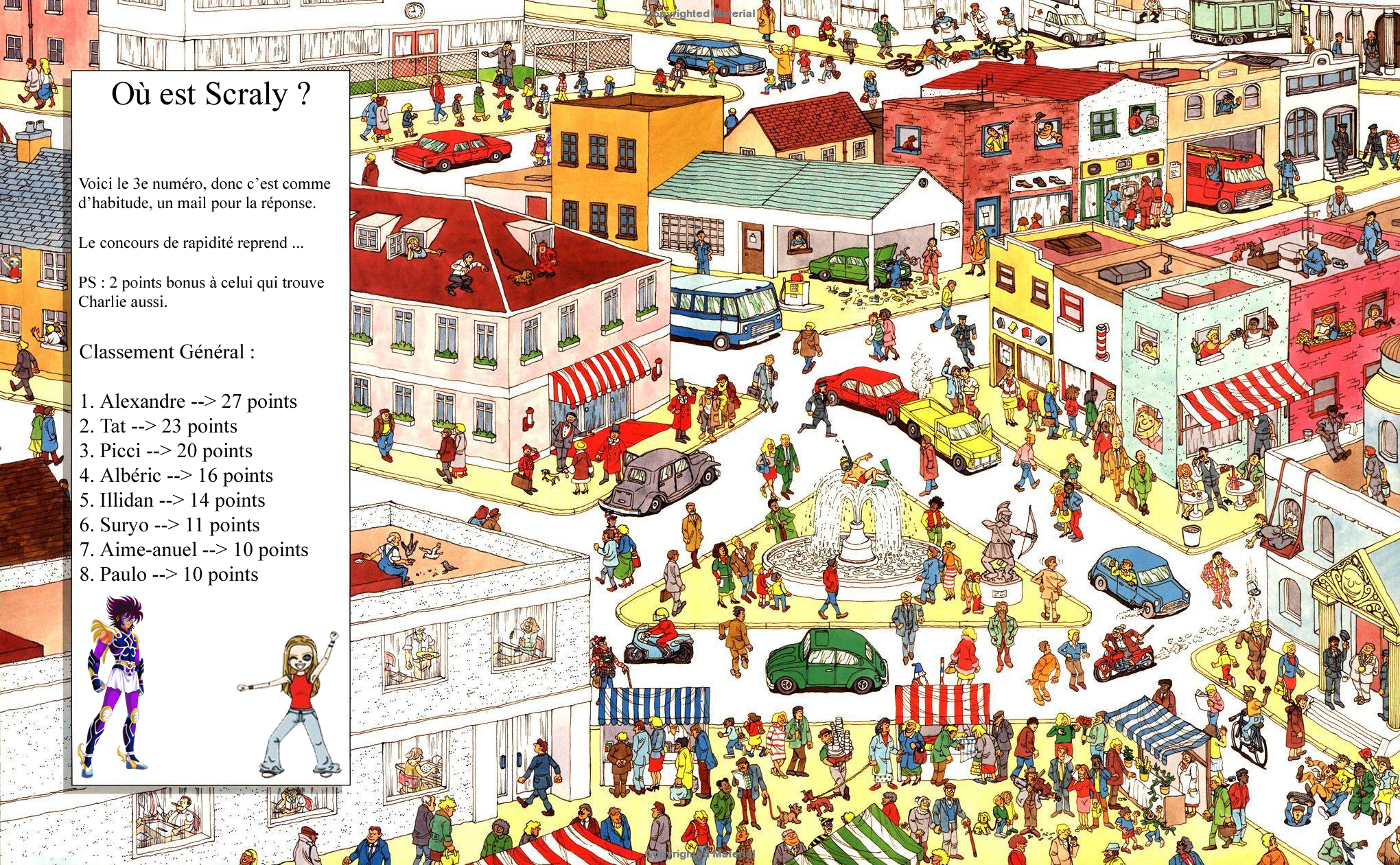
Here is the class handout I created to explain the exercice. (Actually, this is an updated version of the class handout. Almost nothing has changed, except that I swapped around the two games so that the easiest one come first.)
Finally, here are a few web resources you might like about the verb venir and the recent past:
- Exercice: the verb venir in present tense
- Exercice: venir, devenir, revenir
- Venir de: lesson and exercices on Podcast Français Facile
Comments
Post a Comment